
Short answer: How to soundproof a kitchen depends on which of three problems you actually have. Appliance vibration needs isolation — level feet, anti-vibration pads, nothing rattling. Echo inside the room needs absorption — soft surfaces that soak up reflections. Sound escaping to other rooms needs blocking — mass and sealed gaps, above all at the door. Most failed soundproofing projects bought one of these to do another’s job: acoustic foam absorbs echo beautifully and blocks almost nothing.
Kitchens are the hardest rooms to quieten: the surfaces are hard and washable — tile, stone, glass, steel — so sound bounces instead of dying away; appliances vibrate against floors and cabinets that act like sounding boards; and in an open-plan home there may be no door to close at all. Tackle it in the right order — quieten the sources first, seal the leaks second, add absorption and mass only where they genuinely help — and it responds well.
Three Different Jobs: Isolation, Absorption and Blocking
Nearly every “soundproofing” product does one of these three things. Knowing which is which, before you buy anything, is the most useful step in this guide.
| Mechanism | What it does | Typical kitchen fixes | What it will NOT do |
|---|---|---|---|
| Vibration isolation | Stops a machine’s vibration passing into the floor, worktop or cabinets, which amplify and carry it | Level feet, anti-vibration pads or mats, resilient mounts, clearing rattles against the machine | It does not quieten airborne sound — an isolated dishwasher still hums; it just stops drumming through the floor |
| Absorption | Soaks up sound energy inside the room, reducing echo and reverberation so it feels calmer | Rugs and runners, curtains, upholstered seating, acoustic panels (compare their NRC rating) | It does not stop sound reaching the next room — a panel that absorbs echo lets a neighbour hear you almost as well as before |
| Blocking (transmission loss) | Prevents sound passing through a wall, floor or door; measured as STC (Sound Transmission Class) | Sealing gaps, solid-core doors, extra dense board layers, well-fitted cabinets around appliances | It does not fix echo or vibration — a sealed kitchen can still sound harsh inside |
Two ratings keep products honest. NRC (Noise Reduction Coefficient) runs from 0 to 1 and describes how much sound a material absorbs — the number to compare on acoustic panels; it says nothing about blocking. STC describes how well an assembly — a wall, a door — blocks sound passing through. A lightweight product quoting no STC is unlikely to block much, because blocking needs weight.
First, Find Your Loudest Noise Sources
Stand in the kitchen at its noisiest moment — dishwasher running, extractor on, fridge cycling — and work out which problem you are hearing:
- A hum or rumble you can feel through floor or worktop points to vibration: an unlevel appliance, or one touching a cabinet.
- A harsh, echoey quality — claps ring, conversation feels tiring — points to too little absorption for the number of hard surfaces.
- Clear sound in the next room — speech you can follow through a wall or door — points to blocking: usually gaps and a lightweight door.
- Slamming and rattling are impact noise made in the room — cabinet doors, drawers, loose shelves — fixed at the fitting, not with panels.
Fix them in that order — source, leaks, surfaces, structure — because each step makes the next more effective.
How to Quiet a Noisy Dishwasher, Fridge and Extractor
Most appliance noise is made worse by installation details that cost nothing to correct.
The dishwasher
Start with levelling: a dishwasher that rocks even slightly will drum against its housing and the floor. Adjust the feet until it sits firm and level, ensure it is not wedged against cabinet sides, and check hoses are not trapped and buzzing against the back panel. Load it so dishes do not rattle — a surprising share of “dishwasher noise” is the load, not the machine. At replacement time, noise is a declared, comparable figure: dishwashers carry a dB(A) rating, and current models range from roughly 39 dB(A) to the mid-50s, according to Quiet Mark, the independent scheme that certifies appliances for noise; because the scale is logarithmic, that gap is far bigger in the room than on paper. Never wrap a working dishwasher in foam or blankets — it needs its manual’s ventilation and clearances, and wrapping traps heat.
The refrigerator
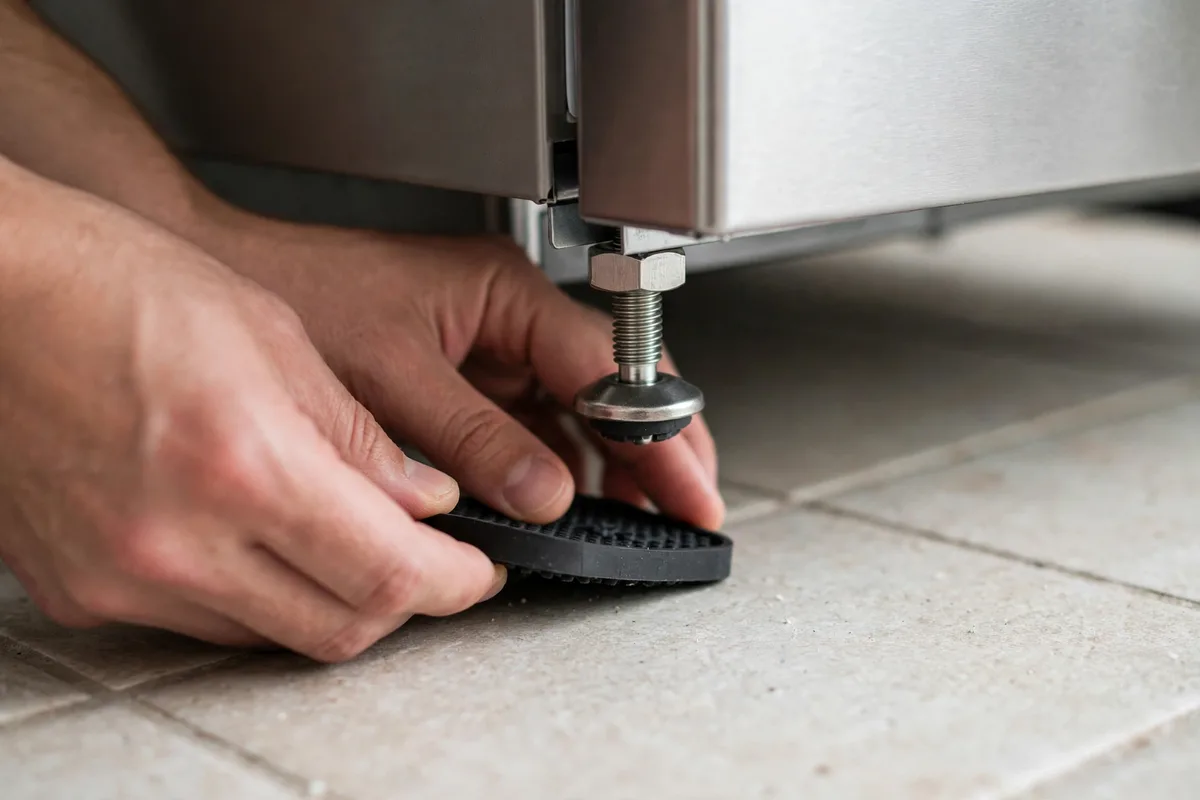
Fridge noise is usually compressor and fan vibration, amplified when the cabinet touches a wall or unit. Pull the fridge fractionally forward so it clears the surfaces behind it, level it, and slide anti-vibration pads under the feet if the hum travels into the floor. Inside, check bottles are not touching and shelves are seated — a loose shelf can buzz in sympathy with the compressor all night. Keep the manual’s clearances and never block the ventilation grille: a fridge that cannot shed heat runs longer and louder, so packing it in backfires. New grinding or a catching fan is a repair issue, not a soundproofing one.
The extractor fan and range hood
The extractor is often the loudest appliance while it runs, and the one whose job you must not compromise: nothing here should obstruct its intake, filters or duct.
- Run it lower and longer. A hood on a low speed for the whole cooking session is far quieter than short blasts on maximum, and it still clears the air.
- Clean the grease filters. Clogged filters make the fan work harder and louder; most metal filters wash in hot soapy water. (See also our guide to how to protect a kitchen backsplash from grease.)
- Check for rattles. A loose filter, damper or duct section is a fitting problem: reseat filters and have loose ductwork secured rather than muffled.
- When replacing, compare sones, not just airflow. Hood noise is rated in sones under HVI (Home Ventilating Institute) certification — lower sones at the speed you actually use means a quieter hood — and long, narrow or bent duct runs make any fan louder.
Blenders, coffee machines and other small appliances
Small appliances are loud in short bursts; the fix is isolation and placement. Stand them on a dense rubber or cork mat rather than directly on a stone worktop, which acts as an amplifier, and use them away from corners. None of this makes a blender quiet — it stops the worktop making it louder.
Seal the Door — and Add Mass Where It Counts
If kitchen sound escapes into a hallway or bedroom, the door is almost always the weakest link — because of the gaps around it, not what it is made of. Sound follows air: any gap you can see light or feel a draught through is carrying sound with it.
Seal every gap first
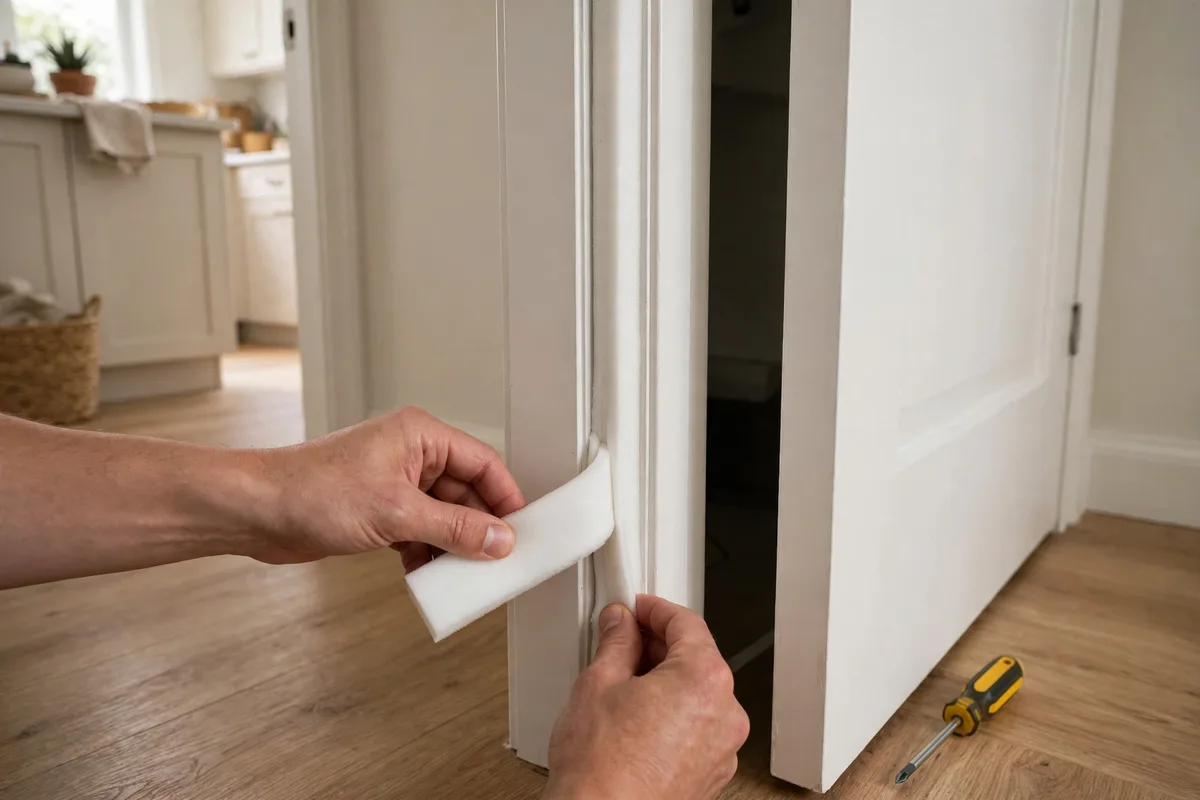
Fit compressible perimeter seals (weatherstripping) so the closed door presses against them on both sides and at the head, and close the under-door gap with a door sweep or drop seal. This is the cheapest blocking upgrade there is, it helps a hollow door as much as a solid one, and it should always come before spending on the door itself — an expensive door left unsealed performs like a cheap one.
When a solid-core door is worth it
If gaps are sealed and speech still comes through the slab itself, mass is next. Typical hollow-core interior doors are commonly rated around STC 20–25, while solid-core doors from major manufacturers test around STC 29–32 — roughly the step from following a conversation to hearing a muffled murmur. Solid-core doors are heavier, so check hinges and frame first; and if the door is a fire door, any replacement or seals must preserve its rating, using hardware listed for that door.
Windows and other openings
The same leak logic applies elsewhere: seal tired window perimeters and gaps around pipework. Never seal a vent that exists for ventilation or combustion air, though — permanent vents in rooms with gas appliances must stay open. Where a vent genuinely carries noise, have a professional fit a purpose-made acoustic vent rather than blocking the grille.
Reduce Echo With Sound-Absorbing Surfaces
If the problem is how the kitchen sounds from inside — echoey and harsh — absorption is the right tool, chosen for grease and moisture as well as acoustics.
Rugs, runners and soft furnishings
The cheapest absorption is soft furnishing: a washable runner along the working path, a rug under the dining area, lined curtains away from the hob, and upholstered stools or chairs all soak up reflections that bare tile and stone return. Choose washable, low-pile, non-slip-backed textiles — kitchen soft furnishings collect grease and spills — and keep loose fabric well away from open flame and hot hobs.
Acoustic panels in a kitchen: what to check
Where soft furnishings are not enough, acoustic panels on a wall away from the cooking zone add real absorption. Check four things before buying:
- A stated NRC rating. Compare like with like; an unrated decorative panel may absorb very little.
- Fire rating. Choose panels with a recognised fire classification (Class A under ASTM E84 is the common benchmark for exposed materials) and follow local code. Craft foam is not a kitchen-safe substitute, and no absorbent panel belongs behind or above a hob, where heat and grease concentrate.
- Cleanability. Kitchens coat everything in grease film. Wipeable or washable facings survive; deep porous foam near the cooking zone does not.
- Placement over coverage. A modest area on the wall opposite the main noise beats thin coverage everywhere.

Open-plan kitchens: zoning instead of a door
With no door to seal, manage sound by distance and absorption. Put the softest, largest surfaces — rug, upholstered seating, curtains — in the living zone; keep the noisiest appliances at the far end of the kitchen run if you are planning a layout; and run the dishwasher when the living area is not in quiet use. A bookcase on the boundary breaks up a bare reflective wall, though it is a modest help, not a barrier.
Stop Cabinets Slamming and Dishes Rattling
Impact noise is the part you fully control, fixed with hardware and storage, not acoustics.
Soft-close hinges, dampers and bumpers
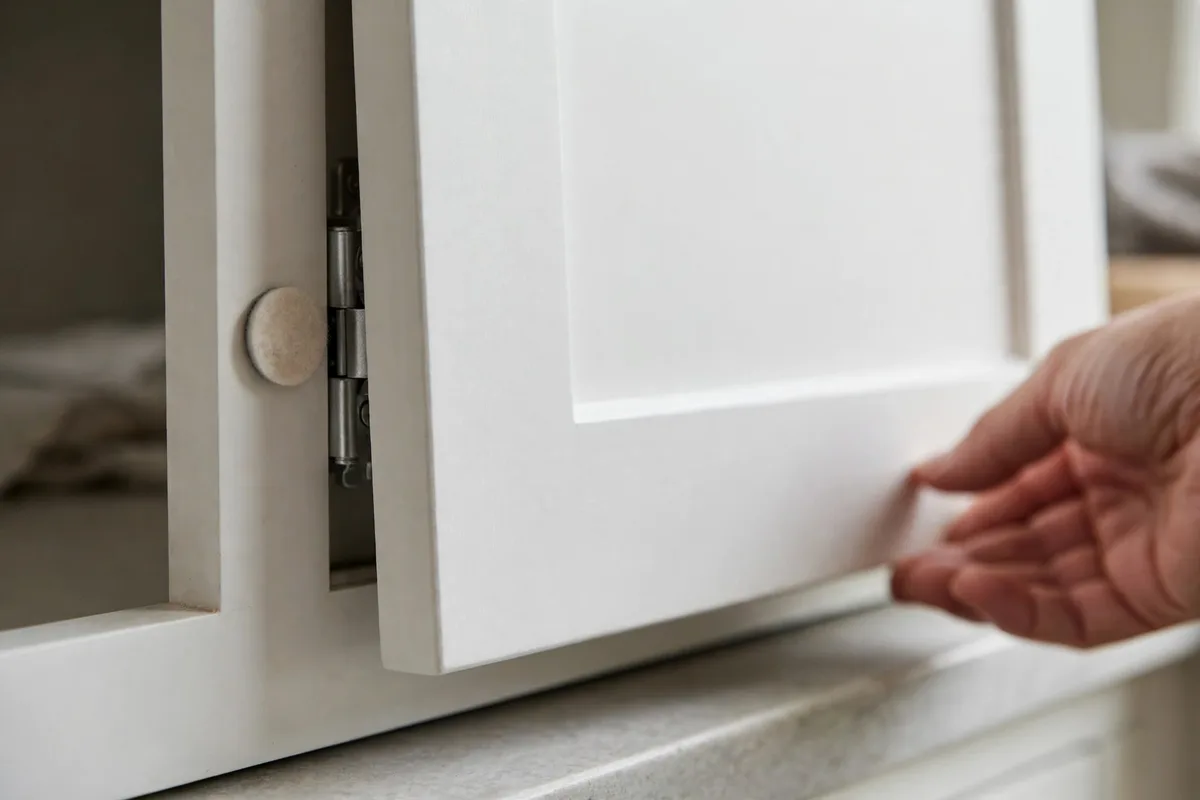
Soft-close hinges or add-on dampers slow a cabinet door in its last inches so it lands instead of slamming; soft-close drawer runners do the same for cutlery drawers. Where new hardware is not practical, felt or silicone bumpers where the door meets the frame remove the sharp clack for pennies. Tighten loose hinge screws while you are there: a door that rattles in its frame needs alignment, not padding.
Liners, lids and loose fittings
Line shelves and drawers with washable non-slip liner so plates and glasses stop sliding and clinking on bare board — an organised cabinet is also a quieter one, and our guide to how to organize a small kitchen covers the storage side. Nest metal pans with a cloth between them, check pan lids are not loose enough to buzz, and put felt pads under chair and stool feet. Individually trivial, together these remove most of the sharp noises that make a kitchen feel loud.
Walls, Ceilings and Floors: The Bigger Jobs
If noise passes through the wall, ceiling or floor structure itself, surface fixes have reached their limit and the honest options are construction, in ascending order of disruption:
- Seal the assembly. Gaps at skirting, sockets and pipe penetrations leak sound through an otherwise adequate wall; acoustic sealant fixes them unglamorously and effectively.
- Add mass. An extra layer of dense plasterboard adds blocking weight, especially with cavity insulation absorbing energy within the wall.
- Decouple. Resilient channels or an independent lining separate the surface from the structure so vibration cannot cross directly — the most effective upgrade, and a professional job.
- Floors from above. Dense underlay beneath hard flooring, or a large rug and pad, reduces footfall noise travelling down.
Two cautions. Ceiling work interacts with lighting and fire safety — if your ceiling has or needs recessed lights, check our guide on whether you need fire-rated downlights in a kitchen before closing anything up. And structural work has diminishing returns while a door gap leaks: seal first, then decide whether the wall still earns the money.
Renter-Friendly Soundproofing for a Kitchen
Renters cannot add mass or decouple walls, but most kitchen noise is in the appliances, gaps and hard surfaces — all treatable reversibly:
- Level appliances and add removable anti-vibration pads under their feet, keeping vents and clearances clear.
- Fit self-adhesive compressible door seals and a removable under-door sweep; both come away at move-out.
- Lay washable runners and a rug with a pad in the dining or living zone of an open-plan layout.
- Add felt or silicone cabinet bumpers and shelf liners — fully removable, and they silence the daily slamming.
- Use mats under small appliances, and run the dishwasher on a timer while you are out of the room.
- Hang lined curtains over a doorless doorway opening, on a tension rod — absorption and a partial barrier in one.
What does not belong on a renter’s list: foam tiles marketed as soundproofing (they absorb a little echo, block nothing, and may not be fire-rated), anything glued over vents or detectors, and any alteration to a fire door. If noise comes through the structure from a neighbour, document it and raise it with the landlord — structural upgrades are the owner’s layer, not yours.
Safety Rules That Come Before Any Soundproofing
- Never block appliance ventilation. Keep specified clearances and grilles exact and open; do not wrap appliances in blankets, foam or vinyl to muffle them.
- Keep absorbent materials away from heat. No panels, foam or curtains where they can contact a hob, oven door or flue; choose fire-rated products (Class A / ASTM E84 where it applies) for anything fixed to a wall or ceiling.
- Never obstruct the extractor or any permanent vent. Ventilation removes steam, grease and, with gas appliances, combustion products; treatment never goes over an intake, filter or grille.
- Choose kitchen-proof materials. Porous materials near cooking absorb grease and moisture as happily as sound; pick wipeable or washable finishes.
- Preserve fire doors and detectors. Do not plane or fit unlisted seals to a fire door, and never cover a smoke or heat alarm.
- Escalate the right noises. New grinding, burning smells or a fan catching are faults, not acoustics — switch off and get the appliance checked.
Frequently Asked Questions
Does acoustic foam soundproof a kitchen?
No. Foam is an absorber: it reduces echo inside the room but does not meaningfully block sound reaching other rooms — that needs mass and sealed gaps. In a kitchen it must also be fire-rated and kept away from hob heat and grease.
Why is my kitchen so echoey?
Because kitchens are boxes of hard, washable surfaces — tile, stone, glass, steel — with little that absorbs sound. The fix is absorption: runners and rugs, lined curtains, upholstered seating and, if needed, rated panels. Echo treatment will not stop sound reaching a bedroom; that is the separate blocking problem.
How do I stop dishwasher noise travelling to other rooms?
Work through the three mechanisms: level the machine and isolate its vibration, seal the kitchen door gaps so airborne sound has no easy path, and only then consider mass — a solid-core door or an extra board layer on the shared wall. A delay timer is a legitimate extra option.
Can you soundproof an open-plan kitchen?
Not in the blocking sense — with no wall or door, there is nothing to seal. You can still make it much less intrusive: quieten appliances at the source, add absorption in the living zone, zone noisy appliances away from seating, and choose quiet-rated replacements. Expect “calmer”, not silent.
What is the cheapest way to make a kitchen quieter?
Start free: level appliances, move the fridge fractionally off the wall, clear rattles, clean the extractor filters, add cabinet bumpers, and seal door gaps with weatherstripping. Together they target vibration, impact and leaks — usually most of kitchen noise — for the price of the seals and pads.
Are quieter appliances worth it when I replace one?
Yes — the rating is declared and comparable in a way retrofit fixes are not. Compare dB(A) for dishwashers, sones (HVI-certified) for range hoods, and look for independent certification such as Quiet Mark. The scale is logarithmic, so a few points lower is noticeably quieter.
Final Thoughts
How to soundproof a kitchen is really three smaller questions: what is vibrating, what is echoing, and what is leaking through. Isolate the appliances, absorb the echo with kitchen-proof soft surfaces, and block the leaks with seals and sensible mass, and the room becomes calmer without a single miracle product. Start with the free fixes, seal the door next, and save construction money for the one wall or door still earning its noise afterwards.

Hello! I’m trying to explore more and provide my readers with more. Besides being a writer, I’ve also worked as an Editor and Proofreader.