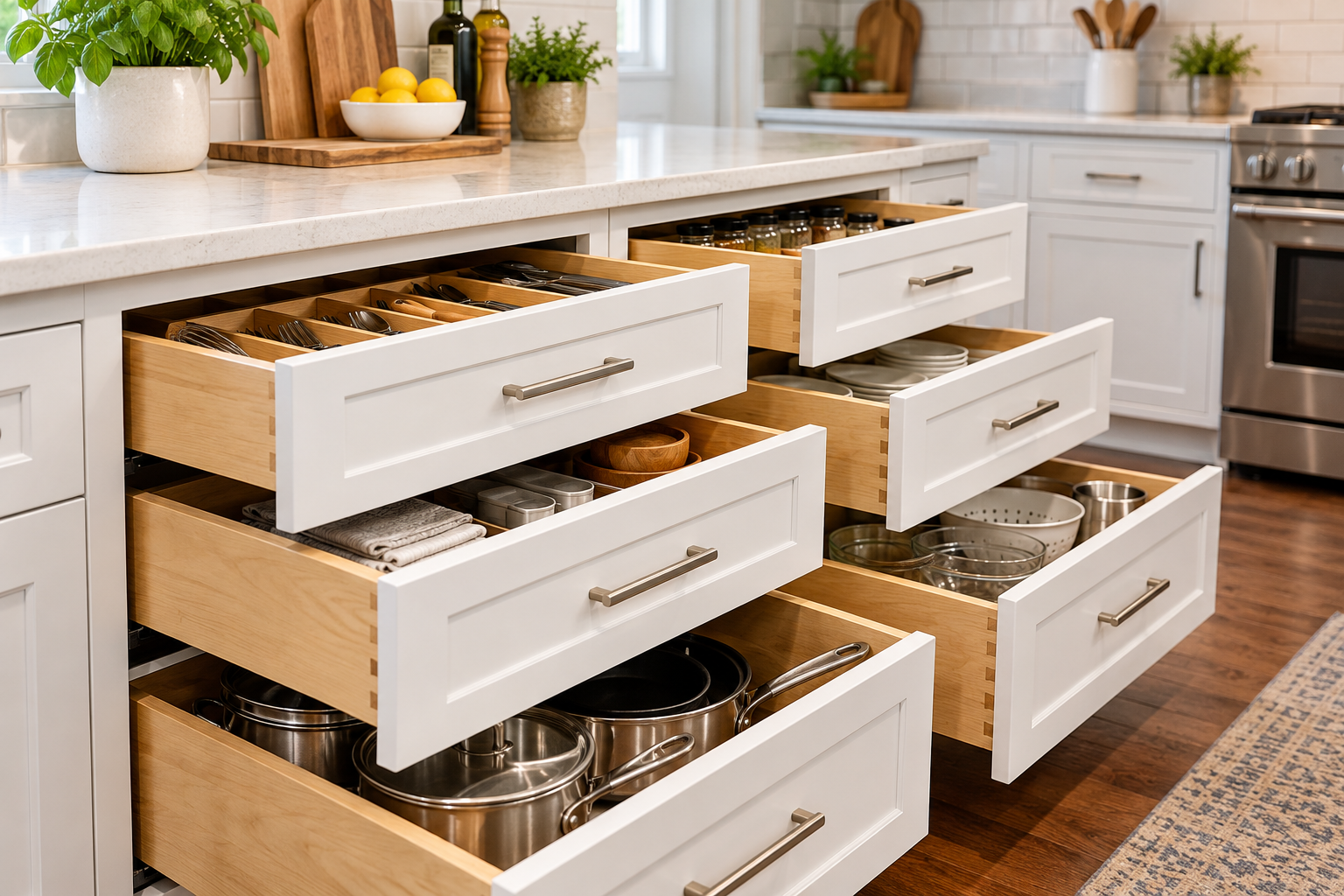
There is no single correct number of drawers for every kitchen — anyone who gives you one magic figure is guessing. But “it depends” is only useful if you know what it depends on. The right count comes from three things: the size of your kitchen, how many people cook in it and how often, and what you actually need to store. Get those three right and the number mostly decides itself — and you avoid the clutter that comes from planning too little drawer storage.
How Many Drawers Should a Kitchen Have?
As a practical starting point, design guidance generally lands in the following ranges. These are counts of individual drawers, and they are planning guidance, not a measured standard — use them to sanity-check a plan, not to dictate one.
| Kitchen size | Typical number of drawers | What that usually looks like |
|---|---|---|
| Small (under 8 m²) | 3–5 | One or two drawer banks covering the essentials |
| Medium (8–12 m²) | 5–8 | Two or three drawer banks, including at least one deep drawer |
| Large (over 12 m²) | 8–12 | Three or four drawer banks, often with an island bank as well |
One counting note before you compare these figures with cabinet advice: drawers are usually grouped in banks — a stack of two or three drawers built into a single cabinet box. A bank of three drawers counts as one cabinet but gives you three drawers, which is why drawer counts and cabinet counts are never interchangeable. If you are working out the cabinet side of the plan, our guide to how many cabinets are in an average kitchen covers unit counts by room size and layout.
The Minimum Drawer Set Every Kitchen Needs
Whatever the size of the room, a working kitchen needs drawers for the same core jobs. Treat these four as the non-negotiable set, and add from there:
- Cutlery drawer — a shallow drawer near the dishwasher or table-setting zone, with a divider tray.
- Utensil and cooking-tool drawer — a medium drawer next to the hob for spatulas, ladles, tongs and peelers.
- Linens and wraps drawer — tea towels, oven gloves, foil, cling film and food bags.
- Deep drawer for pots and pans — one deep drawer close to the hob is worth more than a cupboard you have to kneel and dig through.
A small kitchen that covers just these four jobs with 3–5 well-chosen drawers will work better than a larger one where the drawers were an afterthought.
Drawer Types and Depths
Not all drawers do the same work, and the mix matters as much as the total. A useful rule of thumb for drawer depths:
- Shallow drawers (about 4–6″ deep) — cutlery, utensils laid flat, spice inserts, junk-drawer duty. Shallow drawers keep small items visible in one layer.
- Medium drawers (about 7–10″ deep) — cooking tools, mixing bowls, food storage containers, linens.
- Deep drawers (about 10–12″ deep) — pots, pans, lids, small appliances and bulky items. Deep drawers are the ones that replace the back-of-cupboard excavation.
Where space is tight, a pull-out drawer built inside or beneath a cupboard is another option: it lets you use the full depth of a cabinet without adding a new unit, and pull-outs come in both standard and deep versions. However you mix them, plan at least one shallow, one medium and one deep drawer before adding duplicates of any type.
Plan Drawers by Zone
Designers tend to place drawers where the work happens rather than spreading them evenly around the room. Three zones cover most kitchens:
- Prep zone (near the main worktop and sink) — knives, boards, peelers, mixing bowls.
- Cooking zone (around the hob and oven) — utensils, pots and pans, lids, oven gloves.
- Storage zone (near the fridge, pantry units and dishwasher) — food containers, wraps, cutlery and everyday dishes.
Counting by zone is a good test of your total: if a zone has no drawer at all, something you use daily will end up living on the worktop.
How to Decide the Number of Drawers for Your Kitchen
If you are starting from a blank plan, three factors do most of the deciding.
Consider the number of people who will use the kitchen
The number of people cooking and eating at home is the most critical factor. If you cook for one or two people, a small set of drawers — the minimum set above — is usually enough. A household of four or more, with more cutlery, more cookware and more food storage in rotation, will fill the medium or large range quickly.
How often will you use the kitchen?
Daily cooking justifies more drawers: ingredients, tools and leftovers containers all need a home, and they are reached for constantly. If the kitchen is used lightly — a few meals a week — fewer drawers will do, and you can give the space to cupboards or appliances instead.
How much space do you have?
The room sets the ceiling. In a small kitchen with a large family, prioritise drawers over doored cupboards where you can — drawers use the full depth of the run and nothing gets lost at the back. Remember that appliance positions also eat into the run: every metre given to a range, dishwasher or fridge is a metre that cannot hold a drawer bank, so fix appliance positions first and count drawers in the space that remains.
Drawers vs Cabinets: Which Should You Choose?
It is not really either/or. Doored cabinets are cheaper per unit and better for tall or awkward items; drawers cost more but make the full depth of a base unit usable, especially for heavy pots and everyday tools. Most well-planned kitchens convert at least one or two base cabinets into drawer banks and keep doors where height matters. Our cabinet-count guide covers the other half of this balance — how many cabinets an average kitchen has — if you are planning the whole run.
FAQ
How many drawers are in a 10×10 kitchen?
A standard 10×10 kitchen contains about 11–12 cabinets, and typically one or two of the base units are drawer banks. That works out at roughly 3–6 drawers — in line with the small-to-medium range in the table above. The exact number depends on how many base units you give to drawers rather than doors.
How many drawers does a family of four need?
Usually somewhere in the 6–10 range in practice: the four core drawers, plus extra capacity for more cutlery, cookware and food storage. Where you land inside that range depends on the size of the room — a family of four in a small kitchen should aim for the top of the small range and use drawer organisers well, rather than trying to squeeze in more units.
What is the minimum number of drawers a kitchen needs?
Three is a realistic floor: one shallow drawer for cutlery, one medium drawer for cooking tools and linens, and one deep drawer for pots and pans. Below that, everyday items start living on the worktop — which is the clutter problem most people are trying to avoid.
Do drawers count as cabinets?
A drawer bank counts as one cabinet, however many drawers it contains. So if you are comparing your plan with cabinet counts, convert first: three drawer banks might be three cabinets but eight or nine drawers. The two numbers answer different questions — cabinets tell you how many boxes fit the room; drawers tell you how the storage actually works day to day.
Conclusion
Start with the range for your kitchen’s size, make sure the four core drawers are covered, mix shallow, medium and deep drawers by zone, and then adjust for how many people cook and how often. If you have any doubts regarding the number of drawers for your kitchen, leave them in the comments section and we will try our best to provide some valuable tips.

Hello! I’m trying to explore more and provide my readers with more. Besides being a writer, I’ve also worked as an Editor and Proofreader.